
Industrial Air Compressor Suppliers in Malaysia
Industrial Air Compressor Suppliers In Malaysia. Compare industrial air compressor suppliers in Malaysia using the same operating requirement and complete package scope. Ask for the exact compressor, documented performance, treatment and written after-sales terms.
Table of Contents
ToggleFirst define the duty using our industrial compressor buying guide for Malaysian factories. Then browse the industrial air compressor Malaysia product range and compare written offers against the same requirements.
Choosing industrial air compressor suppliers in Malaysia
Choosing an industrial air compressor supplier in Malaysia starts with your factory’s operating requirement. Provide the airflow and pressure needed by the process, working hours and demand variation. Include existing equipment and any pressure, moisture or reliability concerns.
Compare equipment, package and support together
Ask each supplier to identify the exact model and working point, included treatment equipment, installation responsibilities, warranty terms and delivery timing. Compare operating costs using stated energy prices and running hours rather than assuming the same savings percentage applies to every site.
Shortlist electric compressor sizes
Use our 7.5–315 kW selection guide, including 7.5 kW / 10 HP, 15 kW / 20 HP and 22 kW / 30 HP enquiries. Confirm the offered model’s motor rating and airflow at your required pressure.
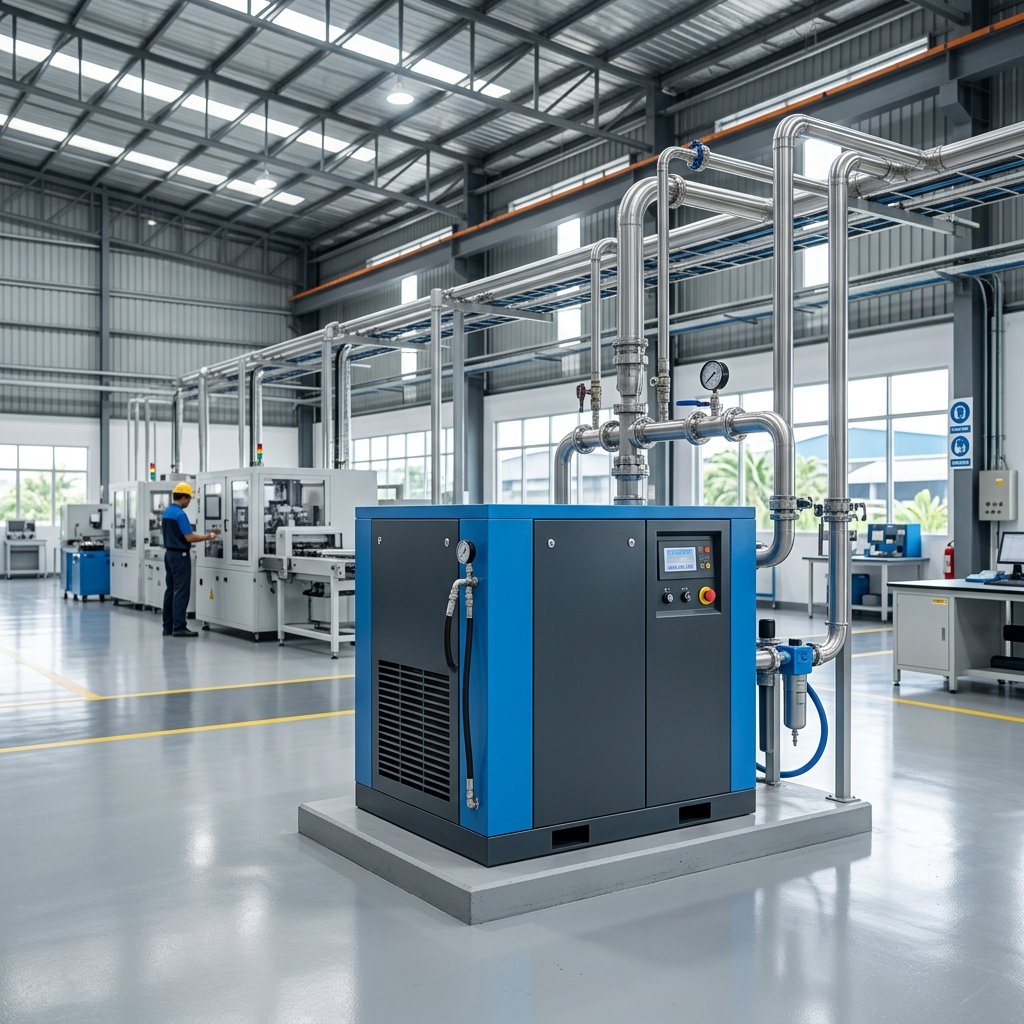
Industrial Air Compressor Technologies Demystified
Rotary Screw Compressors
Compare rotary screw compressor options using the manufacturer’s airflow, package input power and control behaviour at your working pressure. Describe minimum, normal and peak demand so fixed-speed and variable-speed proposals can be assessed against the same duty.
Oil-Free Scroll Compressors
For a process with a specified air-quality requirement, compare the exact oil-free compressor and air-treatment package. Request the applicable manufacturer performance documents and any required certification. Noise, room requirements and maintenance intervals must come from the offered model’s documentation.
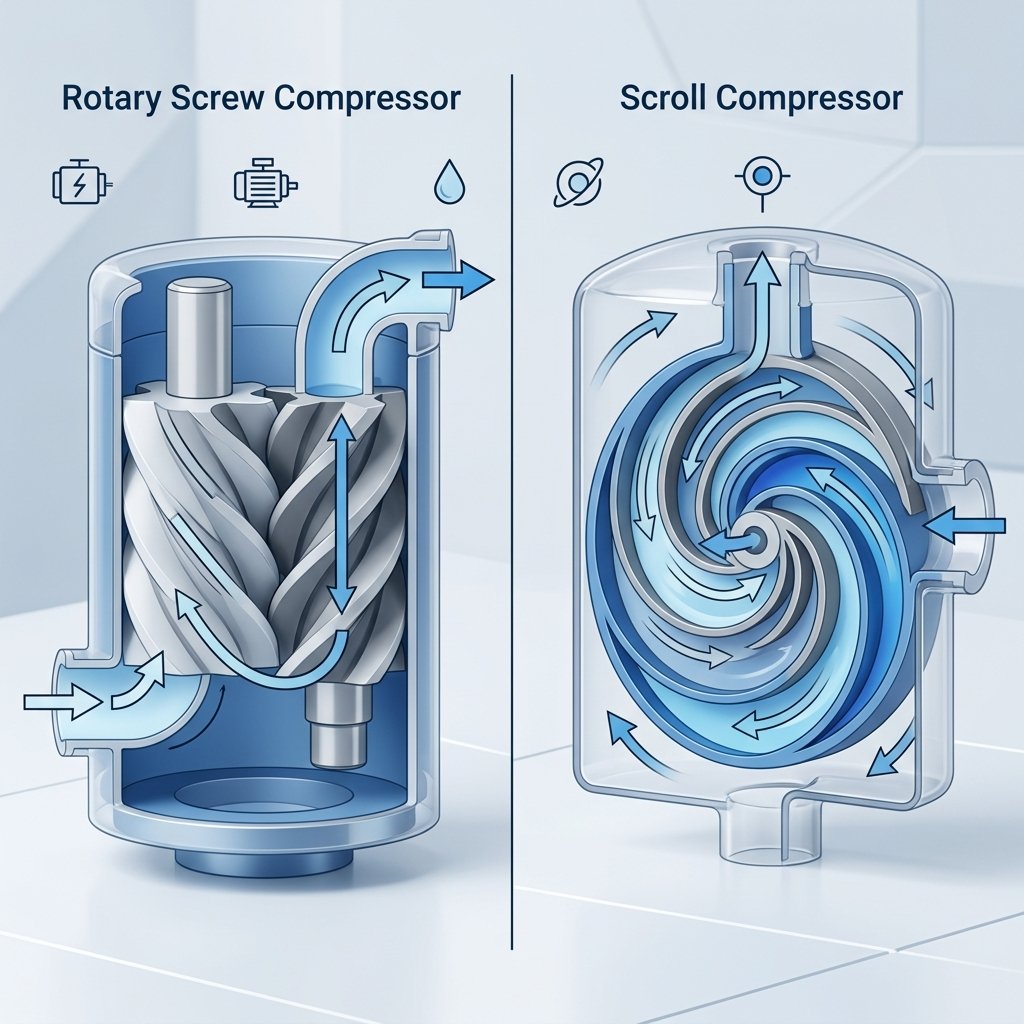
Comparing Screw vs. Scroll Technologies
When comparing industrial air compressor suppliers in Malaysia, request delivered airflow at the same working pressure and documented air quality for the process.
State working hours and demand variation. Compare dimensions, service access, ventilation and electrical requirements for the actual compressor room.
Confirm model-specific warranty coverage, consumable references and service arrangements with the equipment offer.
Essential Air Treatment & Downstream Equipment
A complete industrial compressed air system is much more than just the air compressor itself. Untreated compressed air contains moisture, oil aerosols, dirt particles, and other contaminants that can damage downstream production machinery, cause pipe corrosion, and spoil manufactured products. To ensure high-quality air, a robust air treatment system is required:
- Refrigerated Air Dryers: By cooling the compressed air to a dewpoint of approximately 3°C, these dryers condense and remove water vapor. They are ideal for general manufacturing and pneumatic tools.
- Desiccant Adsorption Dryers: Using chemical desiccants like activated alumina, these dryers achieve extreme pressure dewpoints (-40°C to -70°C). Essential for outdoor piping networks, electronics manufacturing, and pharmaceutical applications.
- Coalescing Filters: These filters trap oil aerosols, dust particles, and liquid droplets. They are graded from coarse pre-filters to micro-filters and activated carbon filters (to remove oil vapor).
- Air Receiver Tanks: Acting as storage vessels, receiver tanks buffer pressure fluctuations, reduce compressor cycling frequency, and cool the air to assist in moisture separation.
Compare fixed-speed and variable-speed operating costs
Compare fixed-speed and VSD equipment against your measured demand profile. Ask each proposal to state its operating assumptions, control behaviour and package input power at the relevant working points. An energy audit enquiry can help define the information needed for a comparison.
Request a written calculation for any projected savings or payback. It should identify the baseline, production pattern, operating hours, energy-price assumption and equipment scope. Confirm the offered motor and drive configuration rather than assuming that every VSD machine uses the same technology.
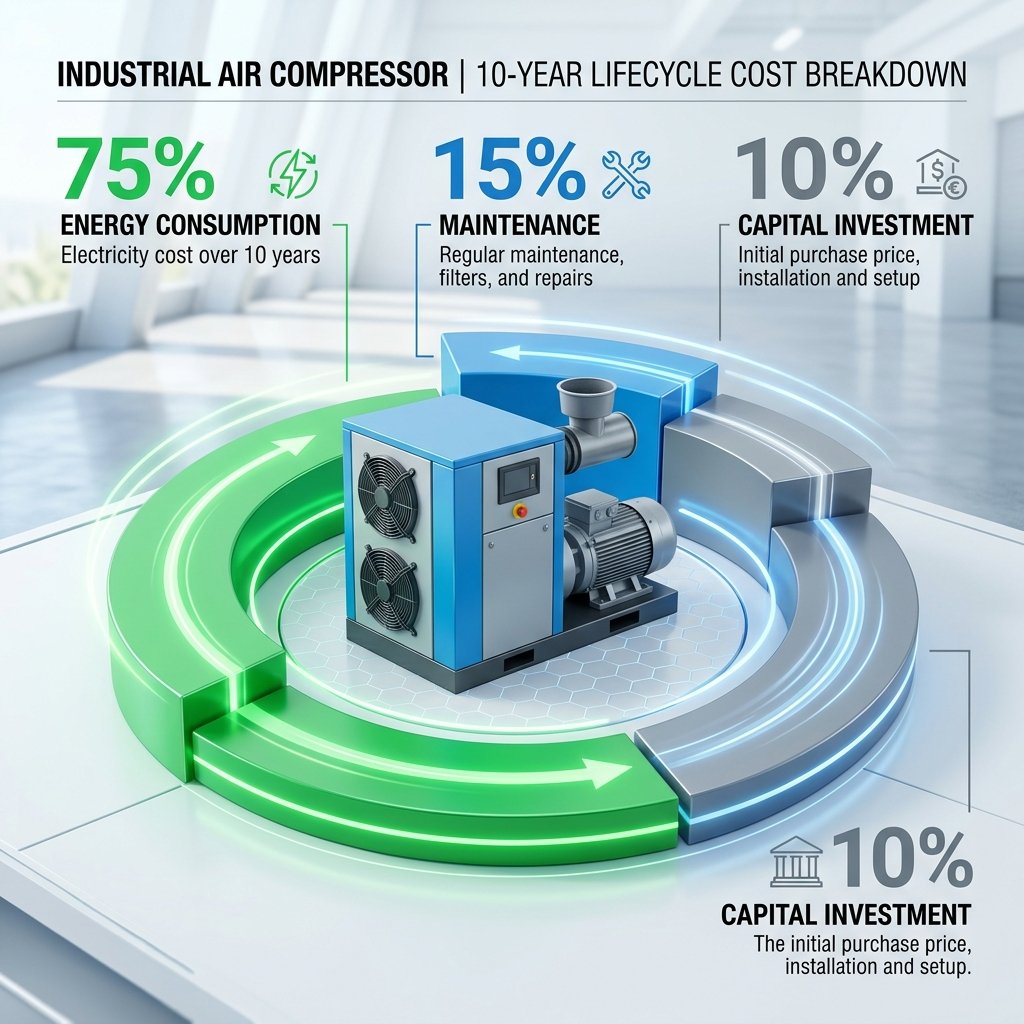
Compare annual compressor electricity costs
Enter measured or documented package power for the same duty. This is an illustrative comparison, using your inputs; it is not a compressor quotation or a promised saving.
Enter the first four inputs to compare annual electricity costs.
The calculation uses constant equivalent power over your entered annual hours. It excludes demand charges, taxes, maintenance, finance costs and changes in production. Simple payback uses only the entered incremental investment and positive electricity-cost difference.
Discuss an energy assessment and its scope · Send your requirements on WhatsAppIndustrial Compressed Air Piping Design Guidelines
Provide a layout showing the compressor room, existing piping and major air users. Include pipe sizes, approximate lengths, connections and pressure concerns at the point of use. Ask the installation proposal to explain its distribution layout, materials, drainage and service-access requirements for the actual factory.
Confirm who is responsible for piping, electrical work, ventilation and commissioning. Compare the installation scope separately from the compressor price.
Analyzing Malaysia's Regional Compressed Air Demand
Include the factory’s exact location when enquiring from Shah Alam, Selangor, Klang Valley or elsewhere in Malaysia. Confirm delivery, site attendance, service arrangements and any travel charges in writing. Ask about parts availability and the attendance arrangements applicable to the actual site.
Describe the actual industry process and its air-quality requirement. Equipment should be assessed against that duty rather than assumptions based only on the state or industrial area.
Comparing Industrial Air Compressor Suppliers in Malaysia
Use the same procurement questions for every supplier so that quotations can be compared fairly.
| Comparison | Information to request |
|---|---|
| Equipment | Exact model, motor rating and delivered airflow at the required pressure. |
| Price | Itemised RM price, taxes, included equipment and installation scope. |
| Service | Attendance arrangements, scope, charges and any written response commitment. |
| Parts | Consumable references, local availability and imported-item lead times. |
| Warranty | Coverage, exclusions, service conditions and claim procedure. |
| Delivery | Availability, transport responsibilities and handover requirements. |
Discuss MAC3 equipment and support with Vortex
Vortex Compressors provides a Malaysia enquiry route for MAC3 France compressed-air equipment. Discuss the factory duty and request a proposal identifying the exact offered model, package performance and support scope.
Explore screw compressors, air treatment and the receiver tank guide. Availability, service timing and warranty terms are confirmed for the supplied equipment.
Industrial Air Compressor Procurement Checklist
Give industrial air compressor suppliers in Malaysia the same airflow, pressure, air-quality and operating brief. Request manufacturer data for the exact proposed models.
Separate equipment-only pricing from the installed package. Confirm delivery, unloading, commissioning, warranty terms, service scope and parts lead times.
Agree any measurement or audit deliverables and fees in writing. Identify the documents and project approvals needed with the responsible project team.
Frequently Asked Questions (FAQs)
Request a scoped factory air-system quotation
Call +60 12 275 7317 or send your enquiry on WhatsApp. Include your Malaysia site location, required airflow and pressure, operating hours and preferred package scope. Price, availability, attendance and delivery are confirmed in the quotation.
Industrial Air Compressor Suppliers In Malaysia: enquiry guide
Use these seven checks to prepare a consistent brief and compare written proposals. Expand the sections relevant to your factory project.
Send industrial air compressor suppliers in Malaysia the same project brief before requesting prices. Identify the factory location, process, expected operating hours and the purpose of the enquiry. Explain whether the project replaces an existing machine, expands production or addresses a current operating problem. These situations can lead to different equipment and installation proposals.
List the information you know and mark estimates clearly. Attach machine nameplates, available airflow or pressure records, and the layout of major air users. State where each measurement was taken and the production conditions at that time. Keep the original units visible so suppliers can check their interpretation.
For several departments, nominate one project contact and collect each department’s requirements in a single equipment schedule. Separate an essential operating requirement from a preference that can be discussed. This makes exclusions and alternative proposals easier to recognise.
Give the brief a revision date. If requirements change, circulate the same revision to every shortlisted supplier. Ask the final offer to identify the brief and revision on which its selection is based.
A comparison of industrial air compressor suppliers in Malaysia should identify delivered airflow at the required working pressure. Motor power alone does not establish that two machines provide the same output. Ask each proposal to name the exact compressor model, its control arrangement and the operating point used in the selection.
Describe the minimum, normal and peak demand where these are known. Identify tools or production lines that operate together, and explain changes between shifts. A short peak and a sustained demand have different implications for a package assessment. Provide supporting equipment data rather than choosing only from a broad motor-size category.
Ask how the proposed compressor will work with machines already installed. The proposal should explain any assumptions about sequencing, standby duties or future expansion. Keep these assumptions visible when comparing fixed-speed and variable-speed options.
Request the relevant manufacturer’s performance information for the actual offered version. If a minimum output is essential, state that requirement explicitly and ask the supplier to address it in writing. A catalogue family name or representative photograph does not identify every configuration.
Tell industrial air compressor suppliers in Malaysia what the production process requires from its compressed air. Include any specified moisture, oil or particle limits, the measurement location and the document that sets the requirement. Distinguish a process specification from a general preference for a particular compressor technology.
Ask the proposal to identify the compressor, dryer, filtration and drain arrangement as a package. The treatment selection should address the offered airflow, pressure and applicable installation conditions. Where a certification or particular test result is needed, request the document for the exact equipment and scope.
Describe existing moisture complaints and where they occur. Share the dryer model, maintenance history and relevant operating records when available. A complaint at a distant outlet may need investigation across the distribution system as well as a review of the compressor-room equipment.
For product contact, medical or other controlled applications, involve the person responsible for the process specification. Have that team review the proposed documentation before purchase. A general description such as oil-free does not by itself confirm that a complete installation meets every process requirement.
Ask industrial air compressor suppliers in Malaysia to separate equipment supply from installation work. List responsibility for delivery, unloading, positioning, piping, electrical connections, ventilation, drains and commissioning. An equipment-only quotation and an installed-system quotation should not be compared as though they include the same work.
Provide photographs or drawings of the intended location and access route. Identify stairs, lifting arrangements, restricted openings and production areas that affect delivery. Ask which dimensions, equipment clearances and site preparations must be confirmed before an order is accepted.
Discuss the shutdown window and the practical effect of downtime. Request a proposed sequence for preparatory work, equipment arrival and handover. Dates that depend on delivery or completion of another contractor’s work should be identified as assumptions rather than treated as firm commitments.
Keep exclusions beside the associated scope item. If your own contractor supplies part of the installation, give both parties the agreed equipment and interface information. Identify who checks readiness for commissioning and who coordinates any outstanding work before the package is placed into service.
When comparing industrial air compressor suppliers in Malaysia, start with an itemised quotation in RM. Check taxes, delivery, treatment equipment, installation, commissioning and any optional items. Record quotation validity and payment terms. A lower headline price may reflect a smaller scope rather than a lower cost for an equivalent system.
For an operating-cost comparison, request the baseline, proposed package power, annual operating hours and electricity-rate assumption. Use representative measured information where available. Keep motor nameplate power separate from measured package input power, and identify any estimate that still requires verification.
The scenario calculator on this page uses values entered by the visitor. It compares the entered power figures over the stated annual hours and electricity rate. It does not establish the performance of a particular compressor or predict demand changes, downtime, maintenance costs or future energy prices.
Use the incremental installed investment when considering simple payback. Request a supporting calculation for any projected saving in a supplier’s proposal. Keep projected results separate from measurements made after installation, and agree the basis for any later comparison before the project begins.
Ask industrial air compressor suppliers in Malaysia which equipment and tasks their support offer covers. Confirm the service contact, attendance arrangements and charges applicable to your actual site. Request any response commitment in writing together with its conditions. A contact address alone does not define the same attendance arrangement for every project location.
For maintenance, use the instructions for the supplied machine and its operating conditions. Ask which inspections and consumables are included in a proposed service package. Confirm how additional work is assessed, quoted and authorised if a visit identifies a further problem.
Record model and serial numbers with the handover documents. Ask for the relevant consumable and replacement-part references, expected sourcing arrangements and warranty terms. Distinguish an item currently available for the quoted job from a general statement that parts can be supplied.
Retain service reports with the equipment history. A useful report identifies work completed, observations and outstanding actions. Review the support arrangement when operating hours, installed equipment or site access conditions change, rather than assuming the original scope automatically covers a revised production pattern.
Before selecting industrial air compressor suppliers in Malaysia, agree which documents and checks form part of the handover. The accepted offer should identify the equipment, configuration, installation scope and any commissioning deliverables. Keep the final equipment schedule consistent across the quotation, purchase order and handover record.
Ask how agreed checks will be recorded and under what conditions they will take place. If the project includes an airflow, pressure or energy assessment, define its measurement locations, production conditions and reporting scope. Avoid leaving an essential acceptance requirement to be interpreted only after equipment arrives.
Identify the people responsible for site readiness, attendance coordination and acceptance. Record any remaining work separately from completed tasks. A component still on order and a future investigation are different open items and should each have an owner and a practical next step.
Keep manuals, equipment identification, accepted variations and resulting reports together. Provide the previous job reference when making a later enquiry. These records help your own team explain what changed and allow the supplier to discuss the next requirement using the correct equipment information.