
MAC3 portable compressors for site enquiries
Construction Air Compressor Malaysia
Looking for a construction air compressor in Malaysia? Discuss MAC3 portable diesel equipment with Vortex Compressors for pneumatic tools, demolition and site work. Tell us the required airflow, working pressure and tools operating together so we can review the appropriate compressor range and supplied configuration. Call +60 12 275 7317 or send your project details on WhatsApp.
Choosing a construction air compressor in Malaysia
A construction enquiry starts with the work to be done. A contractor running one breaker has a different demand from a team operating several tools or a surface-treatment process. List the equipment used at the same time, its documented air consumption and its required pressure. These details give the compressor enquiry a practical basis.
State whether the site has a suitable electrical supply or needs mobile diesel equipment. Include the expected working hours and whether the machine will remain in one position or move between work areas. The compressor’s motor or engine size alone does not define the airflow available to the tools.
Match airflow and pressure to the tool schedule
Ask each tool supplier for its air requirement at the intended working pressure. Record the units so litres per minute, cubic metres per minute and CFM are compared consistently. Describe intermittent tasks separately from sustained operation, and identify the busiest planned combination.
Include the proposed hose lengths and connection sizes in the enquiry. The pressure needed at the tool and the operating point stated for the compressor should both be reviewed. Avoid selecting a machine by adding unrelated catalogue headline numbers without checking the intended working arrangement.
Compare portable diesel compressor options
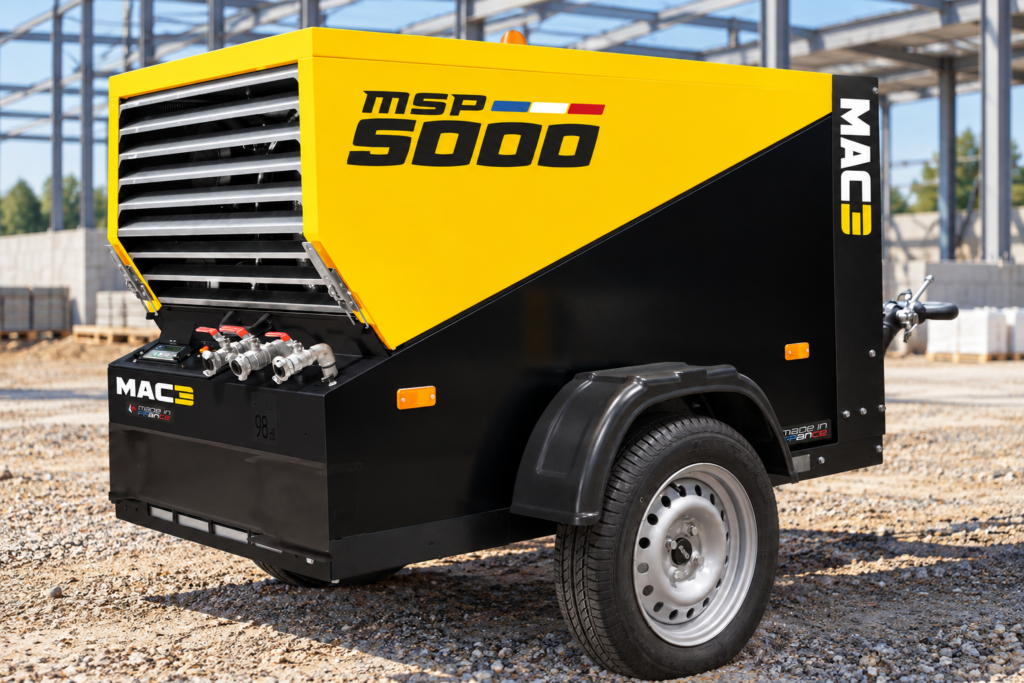
Browse the portable compressor range and the diesel air compressor Malaysia guide. MAC3’s MSP5000 manufacturer information provides model-specific performance and configuration details. Confirm which version is being proposed for your project.
Use the 185 CFM comparison, 250 CFM guide and 400 CFM guide to organise capacity enquiries. A search-class label is a starting point; the offered machine must be compared at the pressure your equipment actually needs.
Site access, transport and handover
Provide the Malaysia project location, access route and available unloading arrangements. Describe any restrictions on dimensions or handling. Ask for the mass and dimensions of the actual skid, axle or trailer configuration in the offer, together with the buyer’s and supplier’s transport responsibilities.
Confirm the intended operating location against the supplied machine’s instructions. Where the compressor will move between projects, include that working pattern in the enquiry. A photograph of an axle-mounted machine does not by itself confirm the complete transport package or arrangements for road use.
Request a clear construction compressor quotation
- Required airflow and working pressure, with the source of each value.
- Tool models, quantities and simultaneous-use schedule.
- Daily working hours and expected project duration.
- Site location, delivery access and unloading responsibilities.
- Requested hoses, connections, treatment equipment and transport configuration.
- Preferred delivery date and any handover requirements.
Request an itemised offer in Malaysian ringgit. Compare the same supplied scope, including accessories, delivery, applicable taxes, commissioning and warranty terms. Local stock, delivery timing and service arrangements should be confirmed in the written quotation.
Plan maintenance and spare parts
Ask which compressor and engine documents accompany the proposed machine and how routine service will be arranged. Retain the model and serial details for later enquiries. Review our compressor maintenance and spare-parts support pages when planning ongoing ownership.
Construction air compressor questions
Can one compressor operate several pneumatic tools?
That depends on the tools’ combined demand and operating pressure. Send the tool schedule and identify which tools run together so the proposed compressor can be assessed against the actual duty.
What should I send when replacing an existing site compressor?
Include its nameplate, current settings and the connected equipment details. Explain whether the replacement is needed for age, service issues or a changed workload, rather than assuming the old advertised class remains suitable.
Discuss your Malaysia construction project
For a construction air compressor Malaysia enquiry, call +60 12 275 7317 or send Vortex Compressors your site requirements on WhatsApp. Include the duty, location and preferred timing so the discussion can focus on a suitable documented proposal.
Construction air compressor project-planning worksheet
Use the following worksheet when the project team first discusses the air supply. It separates confirmed requirements from assumptions and gives procurement, the site team and the supplier one consistent reference. If a detail is unknown, mark it as pending and identify who will obtain it. A complete equipment schedule is more useful than a request for the largest compressor available within a budget.
| Planning item | Information to record | Where to confirm it |
|---|---|---|
| Tools and processes | Make, model, quantity and intended task | Tool documentation and site work schedule |
| Airflow | Required quantity, units and operating point | Equipment supplier’s current specification |
| Pressure | Required pressure at each working connection | Tool or process documentation |
| Simultaneous work | Which tools operate together during the busiest period | Site supervisor’s working plan |
| Working pattern | Daily hours, intermittent tasks and sustained operation | Project programme and intended shifts |
| Site arrangement | Machine position, access, hose routes and unloading | Site team and responsible installer |
| Commercial scope | Equipment, accessories, delivery and handover responsibilities | Supplier’s written offer |
Keep the worksheet with the request for quotation. If the tool schedule changes after an offer is received, send the revised version to the supplier rather than assuming the original proposal still covers the new work. Give each version a date so everyone can identify which operating requirement the quotation addresses.
7 easy checks before ordering a construction air compressor
- Confirm the duty: obtain the tool or process airflow and pressure requirements.
- Confirm simultaneous use: identify the busiest realistic equipment combination.
- Confirm the operating point: compare the proposed machine at the pressure the work requires.
- Confirm the configuration: identify the exact model, engine and skid or transport arrangement.
- Confirm the package: list hoses, connections, treatment equipment and other included accessories.
- Confirm the project scope: agree delivery, unloading, connections and handover responsibilities.
- Confirm ownership support: retain the warranty terms, operating documents and service contact.
These checks form a purchasing review, not an engineering approval for a particular site. Assign the technical questions to the people responsible for the equipment and working arrangement, and keep their responses alongside the quotation. Procurement can then compare offers against an agreed requirement instead of trying to interpret several different headline descriptions.
Construction air compressor example: a small demolition team
Consider a contractor planning intermittent breaker work at one location. The useful starting point is the breaker model and the manufacturer’s stated air requirement, together with the number of operators expected to work at once. The enquiry should distinguish the normal working combination from equipment kept on site as a spare.
Describe the expected working hours and how the compressor will reach the work area. Include the proposed hose route and any restrictions on positioning or access. Ask the supplier to identify the offered machine’s documented working point and included connections. This example does not establish a universal compressor size for demolition; different tools and working arrangements can require different proposals.
Construction air compressor example: several crews on a project
A larger project may have crews working in separate areas, with activity changing during the day. List the combinations that genuinely overlap instead of adding every tool mentioned in the project inventory. Explain whether the intention is to share one supply or request separate equipment for different work areas.
Send a simple site layout showing approximate working positions and the proposed distribution arrangement. Ask how each offered option addresses the same duty and who will review the connections and pressure requirements. Where future work is uncertain, request it as a separately stated scenario so a provisional assumption does not silently become part of the accepted specification.
Construction air compressor example: surface-preparation work
For a surface-preparation enquiry, identify the exact process equipment and its documentation. A broad description such as blasting, cleaning or preparation does not give enough information to select a compressor. Include the operating pressure, airflow requirement and any specified treatment accessories, together with the planned daily workload.
Ask the process-equipment supplier and compressor supplier to review the same operating requirement. Keep treatment performance, compressor output and accessory scope separate in the comparison. A picture of a similar project is useful context, but it does not replace the equipment specification or confirm that a proposed package matches the intended work.
Read a portable compressor quotation line by line
Start with the model reference and configuration. Check that the performance document, equipment description and commercial offer refer to the same machine. Where the supplier offers an alternative, ask for the differences to be stated clearly. Do not combine one configuration’s dimensions or engine details with another configuration’s headline price.
Next, review the supplied package. Ask whether the quotation includes the requested hoses, couplings, treatment equipment, transport components and any agreed handover service. Identify optional items and items supplied by the buyer. This prevents a lower equipment-only price from being compared directly with a more complete package without recognising the difference in scope.
Finally, review commercial terms such as applicable taxes, payment milestones, quotation validity, stated delivery timing and warranty conditions. Ask how a change in the delivery location or supplied accessories would affect the offer. Keep the final agreed specification and terms together so the accepted order can be checked at delivery.
Construction air compressor comparison table
| Compare like for like | What to ask | Why it matters to the enquiry |
|---|---|---|
| Delivered airflow and pressure | Which documented operating point applies? | Headline capacity labels may describe different pressure points. |
| Engine and compressor configuration | Which exact version is supplied? | Market versions and options can differ. |
| Transport and handling | Which components and responsibilities are included? | An illustration does not define the delivery package. |
| Accessories | Which hoses, fittings and treatment items are priced? | Offers should address the same requested scope. |
| Documentation and service | What instructions, warranty terms and support arrangements apply? | The owner needs records for operation and later parts enquiries. |
Use one column per supplier when preparing your own comparison sheet. Record unanswered questions alongside each offer and resolve them before selecting a package. If a supplier proposes an exception to the duty or scope, keep that exception visible rather than treating the offer as directly equivalent to another proposal.
Replacement compressor: information from the existing machine
For replacement equipment, send a clear nameplate photograph and the available compressor documentation. Include the current operating settings and connected tools. Explain why the replacement is being considered: ageing equipment, repeated service issues, a different project or a change in demand can lead to different selection discussions.
If the existing supply has a performance problem, describe the observation carefully. Record when it happens, which tools are in use and whether the condition changes during the working day. The responsible service team can use those observations when deciding what needs inspection. A web enquiry cannot diagnose a fault from the advertised capacity class alone.
Service access and planned maintenance
Ask how the proposed machine will be identified for maintenance and replacement parts. Confirm which compressor and engine documents will be supplied and who will explain the applicable service process. The model and serial details should remain available even if the compressor moves between projects or operators.
Discuss the expected working hours and service location before agreeing ownership arrangements. Ask about the required consumables, the process for requesting parts and the information needed when reporting a problem. Any project-specific support commitment should be documented in the offer rather than inferred from a general statement about local service.
Construction air compressor delivery checklist
At delivery, compare the equipment identification with the accepted quotation and supporting documents. Check the included accessories against the agreed list and record any difference for the supplier to address. Confirm the unloading and handover arrangements previously agreed by the project team.
Retain the quotation, supplied model information, operating documents, warranty terms and service contact together. Ask the responsible team to resolve missing information before treating the equipment record as complete. Where an acceptance test or demonstration is part of the order, its scope and conditions should already have been agreed by the relevant parties.
More questions about construction compressor enquiries
Should I ask for CFM or cubic metres per minute?
Use the units shown in the tool documentation and state them clearly. If you provide a converted figure, retain the original value and its source as well. Ask the supplier to compare the required airflow and pressure together, so the discussion does not mix values from different operating points.
Does a trailer picture mean a trailer is included?
No. Ask the quotation to identify the supplied transport configuration and included components. The photograph is an illustration of equipment, while the written offer defines the actual package. Confirm handling and transport responsibilities for the project separately.
Can the proposal include more than one capacity option?
Yes. Describe the working scenarios you want compared and ask for a separate documented proposal for each option. Keep the model, performance point, accessories and commercial scope consistent within each alternative. This makes it easier to understand what changes when the duty changes.
What if the project requirements are not final yet?
State which details are provisional and identify the information still needed from the tool supplier or site team. A preliminary discussion can help organise the enquiry, but update the duty statement before placing an order. Do not allow an early estimate to be mistaken for a confirmed equipment requirement.
Copy this construction air compressor enquiry outline
Project and location: company, Malaysia site address, project contact and preferred delivery timing.
Work: tools or process equipment, manufacturer references, required airflow and pressure, simultaneous operation and daily working hours.
Site: access, unloading, proposed machine position, hose routes and requested transport configuration.
Package: compressor, accessories, treatment requirements, delivery, handover and service scope to be quoted.
Records: supporting datasheets, written warranty terms and any open questions requiring confirmation.
Send the completed outline through our Malaysia contact page or WhatsApp enquiry channel. Attach relevant nameplate and equipment-document photographs where available. A clear request helps the supplier respond with an offer that the site and purchasing teams can review together.
Construction air compressor performance example
The MAC3 MSP5000 manufacturer table illustrates why the operating pressure belongs beside the airflow figure. It lists 5.0 m³/min at 7 bar, 4.6 m³/min at 8.5 bar and 4.2 m³/min at 10 bar. Use the current documentation for the exact machine being offered; the example does not select equipment for a particular tool or project.
| Published pressure point | Published MSP5000 airflow |
|---|---|
| 7 bar | 5.0 m³/min |
| 8.5 bar | 4.6 m³/min |
| 10 bar | 4.2 m³/min |
For a purchasing review, place the required working point beside the offered model’s documented working point. Ask the supplier to explain any difference before accepting the offer. Do not carry a flow value from a lower-pressure row into a comparison at a higher pressure. Where a datasheet uses rounded CFM labels, keep the original airflow units available so the project team can see the basis of the comparison.
When comparing two machines, ask for their supporting documents in the same enquiry. This is clearer than comparing a capacity in one advertisement with a pressure stated in another. Keep any agreed performance requirement in the final quotation and retain the corresponding document with the equipment record.


