
How to Choose CFM for Sandblasting in Malaysia
Choosing CFM for sandblasting starts with the nozzle and the required working pressure. A compressor’s advertised CFM class alone cannot establish whether it will support your blast setup. Record the actual duty, then compare the proposed compressor’s delivered airflow at the required pressure.
For a Malaysian fabrication yard, coating project or mobile worksite, use these seven checks to prepare an equipment enquiry. The aim is to compare documented configurations and supplied scope, rather than choose a machine from its headline size.
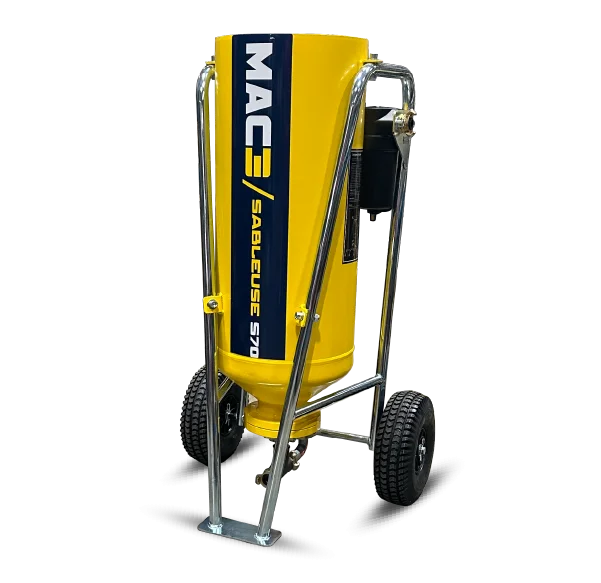
MAC3 S70 sandblaster reference. Confirm the actual nozzle and package in the quotation.
On this page
1. Nozzle · 2. Pressure · 3. Units · 4. System losses · 5. Other loads · 6. Treatment · 7. Quotation
1. Identify the nozzle before choosing CFM for sandblasting
Record the nozzle manufacturer, model, bore diameter and condition. Use the matching manufacturer’s consumption chart at the pressure required by the blasting process. Recheck the nozzle condition when planning replacement equipment; a nominal size on an old purchase order does not confirm its present condition.
MAC3’s S70 product sheet gives an 8 mm nozzle with a 5,000 L/min compressor as a usage tip. That system recommendation is not a universal airflow value for every 8 mm nozzle. Keep the blast-machine guidance and the proposed compressor’s performance documents together.
2. Match CFM for sandblasting to nozzle pressure
The Clemco single-chamber blast-machine manual, Table 2 illustrates why pressure matters. Its 8 mm nozzle example has different air consumption at two nozzle pressures:
| Nozzle pressure | Chart air consumption | Approximate CFM |
|---|---|---|
| 6 bar | 3.4 m³/min | 120 CFM |
| 8 bar | 4.8 m³/min | 170 CFM |
These are two entries from that manufacturer’s chart, not a universal nozzle chart or a complete compressor-sizing recommendation. They should not replace the S70 guidance above. Ask the equipment supplier to verify the working pressure using the blast manufacturer’s approved methods.
3. Compare CFM, L/min and m³/min consistently
For volume-unit conversion, 1 m³/min equals 1,000 L/min and approximately 35.315 CFM. The table’s CFM values are rounded conversions of the stated chart quantities. Converting units does not change the pressure or reference conditions attached to a flow rating.
For compressor comparisons, request the delivered-airflow or free-air-delivery figure, its test or reference conditions and the associated operating pressure. Do not substitute engine power, tank capacity or an unqualified “maximum airflow” figure for that information. A receiver stores air; its volume alone does not establish the compressor’s continuous output.
4. Review hoses, fittings and treatment pressure losses
Ask for a pressure-loss review of the proposed supply hose, blast hose, couplings, filters and other treatment equipment at the intended flow. Provide lengths, internal diameters and connection sizes. Increasing the compressor size without checking the air path can leave the original restriction unresolved.
The compressor outlet reading and the pressure available at the nozzle are different measurement points. Have the supplier reconcile them under working flow. The accepted pressure must also remain within the ratings and instructions of every connected component.
5. Include other loads and an agreed operating allowance
List all nozzles and other equipment that will operate together. Separate simultaneous demand from equipment used at different times, and describe the expected continuous blasting period. Ask the supplier to state its allowance for the actual operating conditions, measured leakage and equipment condition rather than applying an unexplained percentage.
Plan any breathing-air requirement separately with a competent specialist using the applicable equipment instructions and air-quality requirements. A general-purpose compressor, aftercooler or ordinary filter does not by itself establish a suitable breathing-air system.
6. Specify the air-treatment package
Describe the abrasive, coating or surface-preparation requirement and the intended air-quality specification. Ask which cooler, separator, drains, filters or dryer are proposed, their pressure losses and the conditions for their stated performance. Include the site’s expected ambient conditions in the enquiry.
MAC3 documents an integrated aftercooler option for its 2,000–3,000 L/min range. An option on a product family is not automatically included in a particular offer. The quotation should identify the equipment supplied and how condensate is managed; “aftercooler fitted” alone is not a complete air-quality specification.
7. Request a documented compressor quotation
To discuss CFM for sandblasting with Vortex, send the following details together. This lets the proposed compressor, blast equipment and site arrangements be reviewed as one package.
- Nozzle make, model, bore and the manufacturer’s required working pressure.
- Number of simultaneous nozzles and any other connected loads.
- Hose lengths, internal diameters and connection details.
- Operating hours, continuous blasting periods and required air treatment.
- Site address, access, unloading arrangements and the preferred skid or trailer configuration.
- Required model documents, supplied accessories, commercial scope and delivery timing.
Start with the portable diesel compressor range, the S70 product page and our surface-treatment application guide. A capacity guide is a comparison starting point; the written offer should identify the exact model and pressure configuration.
CFM for sandblasting: sizing questions
Is a 185 CFM compressor enough for sandblasting?
It depends on the nozzle chart, working pressure, simultaneous loads and system losses. A “185 CFM” label is not a nozzle-pressure guarantee. Ask for the actual model’s documented airflow at the required pressure before selecting the package.
Can I convert PSI directly into CFM?
No. PSI describes pressure and CFM describes volumetric flow. A nozzle consumption chart relates the two for a specified nozzle and test conditions; there is no single pressure-to-flow conversion for all blasting systems.
Does an aftercooler mean a dryer is unnecessary?
The required treatment depends on the application’s air-quality specification and operating conditions. Ask what the proposed package achieves, how that performance is documented and which additional treatment, if any, is required.
Request a sandblasting compressor proposal
Send your nozzle details and Malaysia site address to Vortex Compressors on WhatsApp at +60 12-275 7317. Ask for the proposed equipment, airflow at pressure, treatment package, delivery scope and support arrangements in the written quotation.
Technical references checked 18 October 2026. This article supports equipment selection enquiries; operation and maintenance follow the instructions for the actual supplied equipment.